Why AI adoption is high but integration is failing in martech
Why AI adoption is high but integration is failing in martech

{
“@context”: “https://schema.org”,
“@type”: “AnalysisNewsArticle”,
“headline”: “Why AI adoption is high but integration is failing in MarTech”,
“description”: “While marketers have rapidly adopted AI tools, most organizations struggle with deep integration due to a lack of strategic roadmaps and the prevalence of ‘bolt-on’ AI features that add manual work rather than automating core operational tasks.”,
“datePublished”: “2026-04-01T08:00:00-05:00”,
“dateModified”: “2026-04-01T08:00:00-05:00”,
“author”: {
“@type”: “Person”,
“name”: “Frans Riemersma”,
“jobTitle”: “Founder of Martech Tribe”,
“url”: “https://www.linkedin.com/in/fransriemersma/”,
“sameAs”: [
“https://www.linkedin.com/in/fransriemersma/”
]
},
“publisher”: {
“@type”: “Organization”,
“name”: “MarTech.org”,
“logo”: {
“@type”: “ImageObject”,
“url”: “https://martech.org/wp-content/themes/martech/assets/img/martech-logo.png”
}
},
“mainEntityOfPage”: {
“@type”: “WebPage”,
“@id”: “https://martech.org/why-ai-adoption-is-high-but-integration-is-failing-in-martech/”
},
“speakable”: {
“@type”: “SpeakableSpecification”,
“cssSelector”: [
“h1”,
“.article-content p:first-of-type”
]
},
“backstory”: “This analysis is built upon data from the 2025 State of Marketing AI Report and Gartner research, which highlight that over 50% of organizations lack the necessary governance and stack readiness for effective AI integration. The reporting also utilizes expert insights into the ‘marchitecture’ gap between AI suggestion engines and true execution systems.”
}
AI agents are rapidly appearing across company stacks, but most remain isolated in use cases rather than integrated into core workflows. While 90.3% of companies report using AI agents, only 23.3% have them in production and just 6.3% have fully integrated AI into their marketing stack.
Adoption is high because AI is easy to deploy in isolated tasks. Integration lags because stitching those outputs into governed, system-of-record workflows is far more complex. In martech, the real constraint isn’t access to AI — it’s aligning probabilistic outputs with deterministic systems without breaking control, compliance or consistency.
Data shows that organizations are not replacing SaaS with AI. They’re layering probabilistic AI on top of deterministic SaaS systems that still run the business. The challenge is making these systems work together without creating fragmentation or loss of control. The agentic stack provides that model, and it varies significantly by company size.
Deterministic SaaS and probabilistic AI play different roles, but must operate in the same stack. Systems of record remain the foundation. They store data, enforce rules and answer one question: What is true?
AI agents interpret situations and decide what action to take. They answer a different question: What should happen next?
At its simplest, the agentic stack works like this.
- Context = guardrails: Pricing rules, product availability, legal and brand rules, define what is allowed.
- Intent = situation: What the customer wants and what they are trying to do defines what is happening.
- Agents = decisioning: Reconcile both to decide what to do
It enables AI to operate across SaaS. Integration becomes more critical, but also more complex to control, because decisions now depend on orchestrating data, rules and context across multiple systems in real time.
The SEO toolkit you know, plus the AI visibility data you need.

@media (max-width: 768px) {
.headline-responsive {
font-size: 30px !important;
line-height: 1.3 !important;
}
}
How the agentic stack works in practice
Here’s a simple example. A customer asks for the price of a product via chat.
In a traditional stack, this triggers a lookup. The system retrieves a price based on predefined rules. The answer is correct, but not relevant to the customer.

In an agentic stack, the same request becomes a coordinated decision. The agent retrieves pricing rules, product constraints and contractual agreements from systems of record while also evaluating customer context such as behavior, timing, channel and profile.
- Customer context defines who the answer is for. It reflects the customer’s current situation, not just their stored attributes.
- Content context defines what can be said. This includes pricing logic, product availability, brand tone and regional or legal boundaries.
The agent combines both, crafting a response that aligns with the company’s rules and the customer’s moment. The outcome is accurate and relevant. The right price becomes the right message, delivered in the right way.
How the agentic stack changes by company size
The agentic stack scales through changes in how intelligence is defined, integrated and controlled, not by adding more tools or agents.
Smaller companies and scaleups are often the most aggressive adopters of martech and AI. They rely on tools to drive growth, reflected in both higher relative martech spend and their integration approach.
More than half of SMBs (53.6%) rely on iPaaS solutions such as Zapier, Make or n8n to connect systems, compared to just 20% in enterprise environments. They also adopt AI through accessible entry points, with 32.1% integrating agents via iPaaS or automation platforms, versus only 8% in enterprises. This enables rapid experimentation, but distributes business logic across tools and workflows.

As complexity increases, the limits of this approach become visible. Mid-market companies begin to formalize their stack, combining iPaaS, pre-built integrations and selective custom work. Decision logic starts to move beyond individual tools and an explicit intent layer begins to emerge.
In enterprise environments, integration shifts toward control and ownership. Nearly three-quarters (72%) rely on custom-built integrations, compared to 53.6% in SMBs. Enterprises also embed AI more deeply into assistants and core platforms (52% versus 46.4% in SMBs), while facing significantly higher challenges. Integration friction reaches 68% (versus 41.1% in SMBs), governance constraints 48% (versus 26.8%) and cost observability 44% (versus 17.9%).
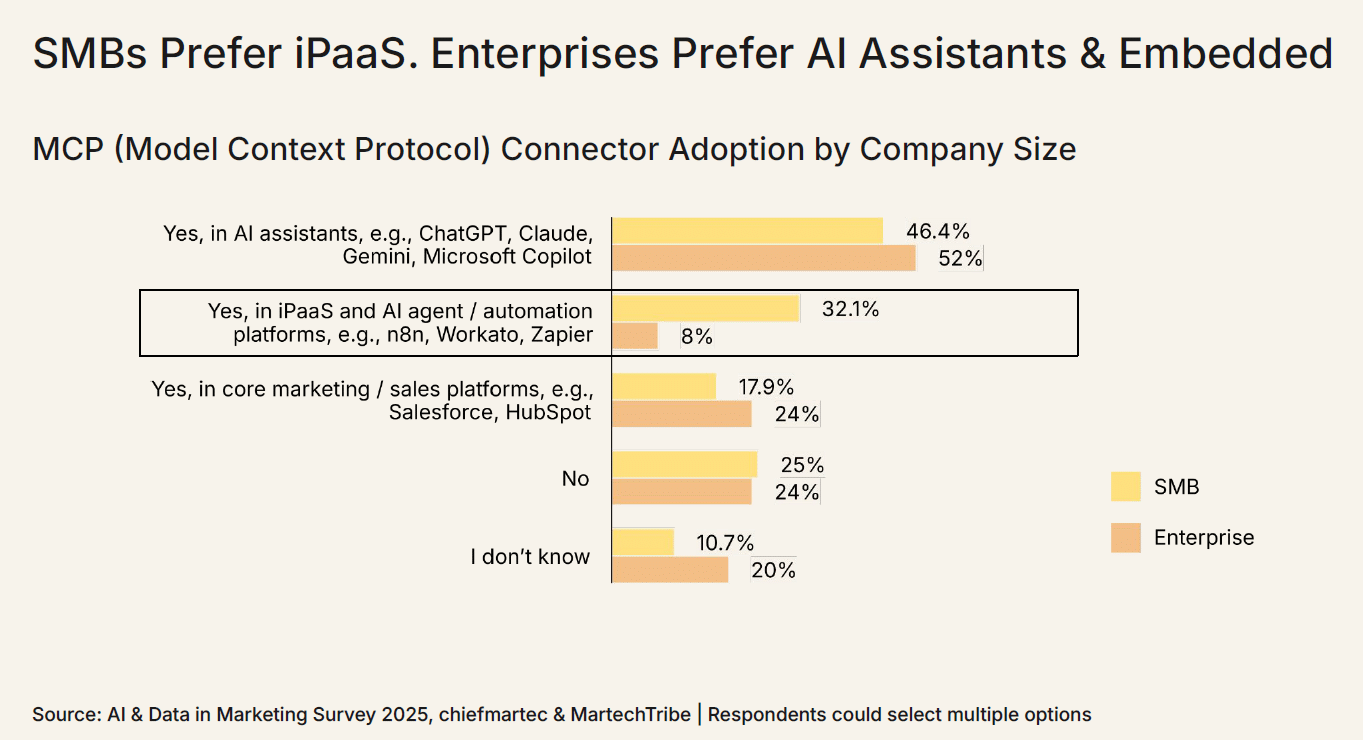
Agentic maturity is defined by how effectively organizations integrate systems and govern decision-making across them. As companies grow, the challenge shifts from enabling intelligence to controlling where and how decisions operate across an increasingly interconnected stack.
Retail as an example
Retail provides a useful example of how the agentic stack evolves as organizations grow. This example also plays out clearly within a single vertical.
Let’s look at two perspectives: overall stack maturity and size, and, more specifically, one category: integration and tag management.

Overall maturity increases with company size. Small retailers average a maturity of 2.6, mid-sized retailers 2.8 and large retailers 2.9. Stack size also grows, from roughly 60% of large retail stacks in small companies to full scale in enterprise environments.
Integration tells a different story. This category enables companies to collect customer data and connect systems, allowing data to flow across platforms, build custom (AI) workflows and execute agent-driven decisions across the stack.

As stacks grow, however, connecting systems, managing data flows and maintaining consistency become harder, widening the gap between capability and coordination.
Small retailers build tightly connected stacks focused on direct revenue impact. ecommerce, CMS, CRM, customer service and performance marketing tools are often linked through iPaaS solutions. Agents already support use cases such as product content generation, ad optimization and customer interactions. But decision logic remains distributed across tools, making consistency difficult to scale.
Mid-sized retailers expand toward coordination. As campaign volume increases and more channels are added, systems are integrated more deliberately. Agents begin to operate across workflows and decision logic becomes more explicit.
Large retailers operate at a different scale and build their stack around integrated systems of record, including CDP, CDW, PIM and MRM, supporting large volumes of data and campaigns. Agents coordinate decisions across these systems, from pricing and promotions to personalization. At the same time, increased complexity makes it harder to maintain control over decision-making.
Across all three, the pattern is consistent. The stack not only grows, but it also becomes harder to manage. The shift is from enabling execution to controlling decisions. That is the real change the agentic stack introduces.

The post Why AI adoption is high but integration is failing in martech appeared first on MarTech.
⚡ Hot Amazon & Walmart Deals
Discover exclusive discounts from Amazon and Walmart – shop trending products and save big today.
🎮 MMO & AI Tools – Earn Online Smarter
Join the MMO community and explore powerful AI tools designed to maximize your online income.
💼 Affitor Pro & AI Side Hustles
Leverage AI to generate smarter profits and build sustainable passive income streams.
🚀 Hosting & Tutorials
Learn how to build profitable websites fast with Hostinger tutorials and AI‑powered strategies.